The same plant, hardy in your yard, is not hardy in your pot.
That is not a quirk of one species. A hardiness rating describes a plant growing in the ground, where soil holds heat and blunts the cold.
In a container, the roots sit in air on every side, and they drop to close to the air temperature. Roots are the part that cannot take it.
So the question for each pot is not whether the plant is hardy. It is whether it stays hardy with that buffer gone.
For most balcony containers the answer is a rating two zones colder than your own, a spot against the building, and a heavy mulch.
The rule, and where two sources disagree
The University of Illinois runs a free public advice service called Extension. It gives the general rule of thumb as plants rated two zones different from your own.
The University of Nevada, Reno runs the same kind of service and is looser. It says plants hardy to one zone below yours can stay out, in a large winter-proof pot.
Read Nevada’s version with its conditions attached. The allowance is tied to a large pot, and a small or thin-walled one loses it.
Both sources agree on why, and Illinois states it plainly. Roots are far less cold hardy than the stems and trunks above them.
A zone 5 shrub on a zone 6 balcony could go either way. The same shrub rated to zone 4 will almost certainly hold.
Check the hardiness zone from the USDA, the US government’s agriculture department, on the plant label, then subtract two.
Roots are far less cold hardy than the stems and trunks above them.
The building wall does most of the work
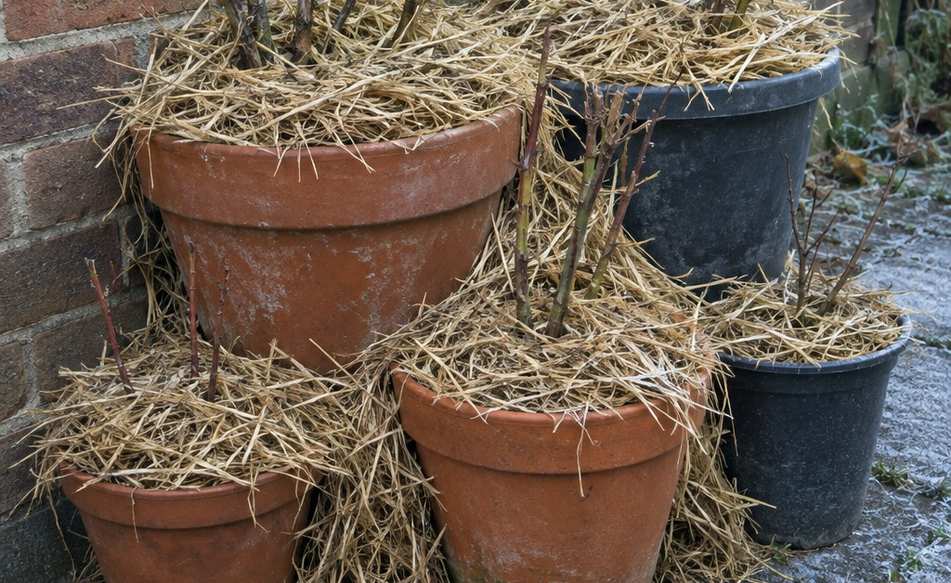
Nevada recommends grouping pots together, out of the wind and close to the house. Illinois says the same, and adds heavy mulch over the top.
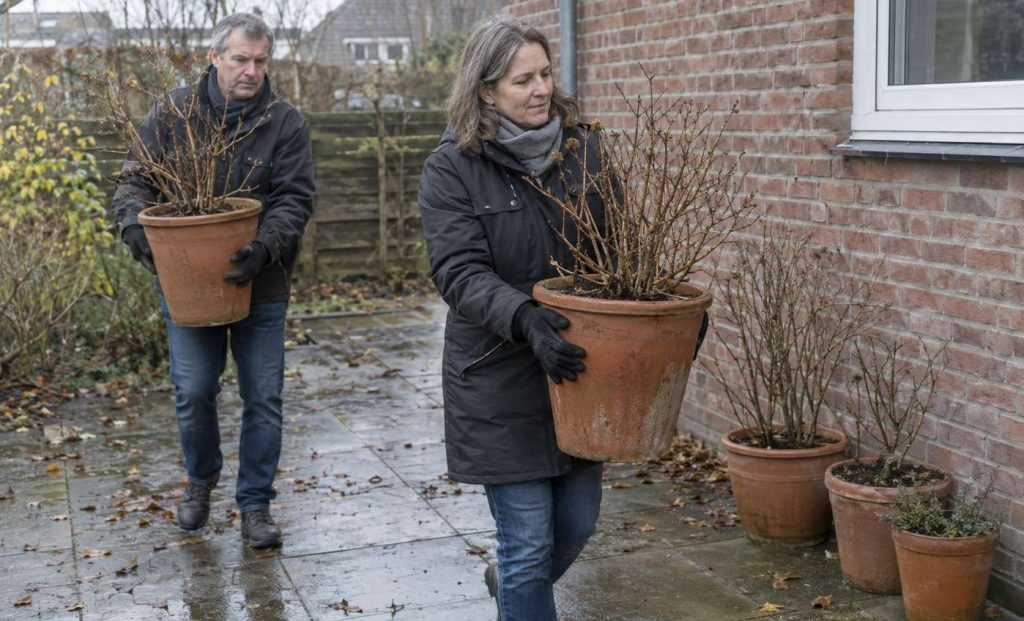
A heated building’s wall is the warmest surface on any balcony, and it costs nothing. Push the pots against it, not out by the railing where the wind reaches them.
Then mulch. Illinois names straw, leaves, or wood mulch, piled on thickly rather than sprinkled.
Both sources also suggest sinking the pots into open ground so the surrounding soil insulates them. On a balcony there is no ground, so that option simply does not exist for most readers here.
Group, shelter, mulch.
That is the whole outdoor method, and not one of the three costs anything:
- Push the pots into one block so they shelter each other.
- Put that block against the building, out of the wind.
- Pile straw, leaves or wood mulch over and around them.
Small and thin-walled pots belong in an unheated space
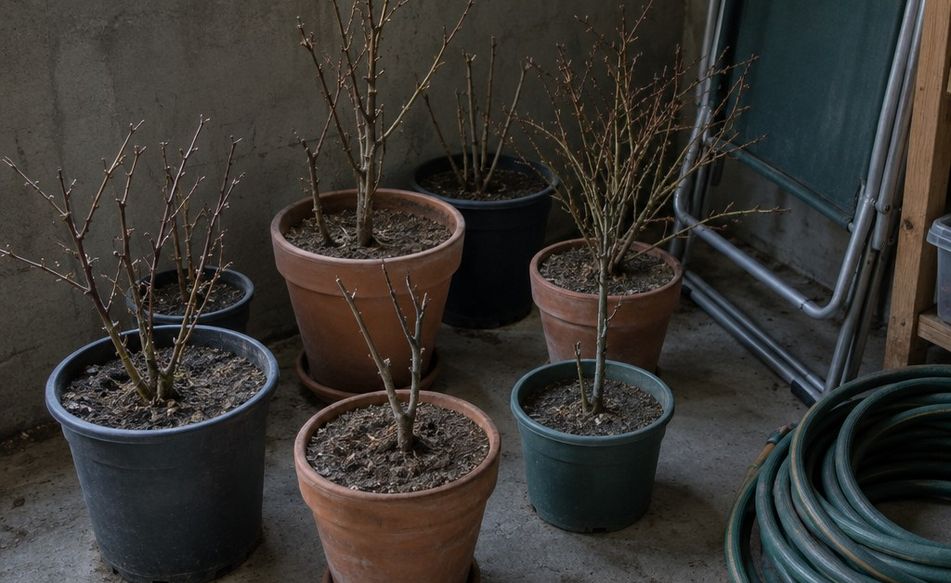
Nevada is direct about this. A cold-hardy plant in a small or thin-walled container should go into an unheated garage rather than stay out.
Illinois puts the target range for that space at 20 to 45 degrees Fahrenheit. Cold enough to keep the plant dormant, warm enough that the root ball never sits at outdoor lows.
An unheated garage, an unheated basement, or a stairwell that never freezes hard all qualify. A heated room does not, because the plant wakes up and then has no light to grow with.
The same logic is one more reason pot volume matters as much as it does. More mix around the roots means more material holding warmth between them and the cold.
Cold enough to keep the plant dormant, warm enough that the root ball never sits at outdoor lows.
Keep watering, sparingly, all winter
This is the step almost everyone skips. Illinois notes that roots keep taking up water even after the top growth has gone dormant.
A pot in a dry garage can die of drought in February with snow on the ground outside. Check it monthly and water lightly when the mix is dry.
Once a month is the whole job.
There is a second reason. Illinois notes that moist growing media freezes slower than dry media, which is protection in itself.
Nevada’s wording is the safest summary: water sparingly, so the pot never dries out completely. Sparingly is the important word, because a dormant root sitting in water rots.
If you want a physical layer over the top of an outdoor pot, you can compare plant frost protection covers on Amazon. Look for a breathable fleece rather than plastic sheeting.
Heads up: some links on this page are affiliate links. Buying through them supports the site with a small commission and does not raise your price.
What will not overwinter at all
Not everything on the balcony is a candidate, and pretending otherwise wastes a good corner.
Annuals were bred to finish in one season, and no method brings them back:
- Basil, tomatoes and most summer vegetables.
- Petunias, lobelia and the rest of the bedding tray.
- Anything the label called a patio annual.
Illinois names geraniums as a plant that needs different handling entirely. They are the awkward middle case rather than a true annual.
The rest belong on the compost heap in October, and that is not a failure of care.
Let them go.
Tender tropicals are the third case, and they are doing something else entirely. They come indoors as houseplants, which is a different job from holding a dormant hardy plant through the cold.
For the pots that do stay out, the perennials that come back on their own are the ones worth the mulch and the wall.
The annuals were never coming back, whatever you did with them. Sorting those out first makes the rest of the job small.