How many days can a pot go without you?
That is the question worth answering before a trip, and the answer is shorter than most people hope.
A small container in hot, windy weather can need water once or twice a day. A large one in cool weather may be fine for a week.
So there is no single number to look up. There is a number for your balcony, and three mornings will tell you what it is.
Once you know it, three free moves stretch it: a soak the night before, shade, and pushing the pots together. Past roughly a week, stretching stops working, and you need a reservoir, a timer or a neighbor.
Measure how fast your own pots dry
Iowa State University Extension publishes free gardening guidance, as every American state university’s extension service does.
Its figure for containers is anywhere from twice a day to once a week. Pot size and weather decide where you land.
That is a sevenfold spread. Two balconies in the same city can sit at opposite ends of it.
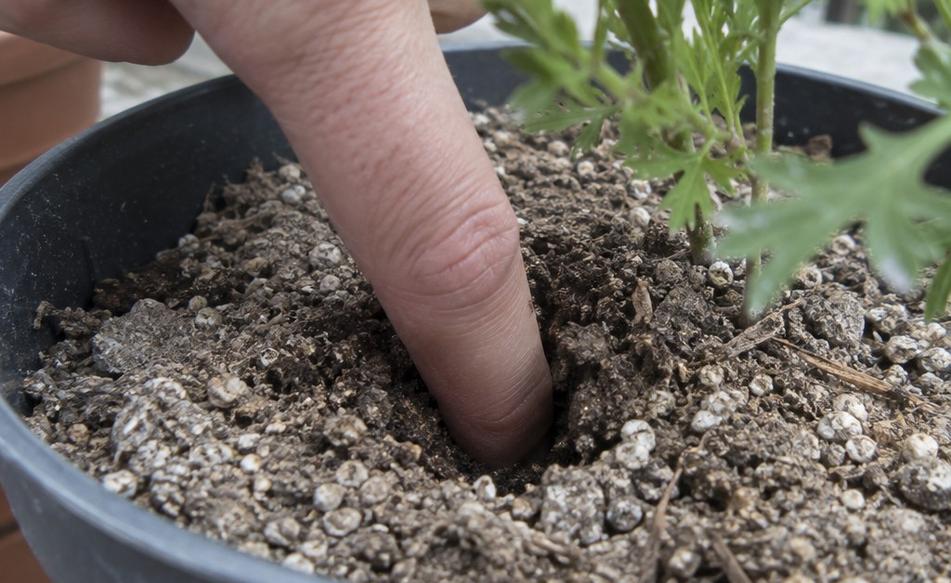
A pot dries far faster than open ground, which is why the daily finger check exists at all. That habit is also your measuring tool.
Iowa State says to water when the potting mix is dry at a depth of 1 to 2 inches. So run that test for three mornings before you go:
- Push a finger into each pot, 1 to 2 inches down.
- Note which pots are already dry at that depth.
- Write down the first one to hit dry each morning.
Three mornings is enough to find your number.
That first pot sets your limit, not the biggest one on the balcony. Everything you do next is aimed at it.
Two balconies in the same city can sit at opposite ends of it.
A soak on the morning you leave buys less than you think
Watering hard on the way out of the door feels like insurance. It is not, because a soaked pot sheds its surplus within the hour and holds only what the mix can grip.
What a soak gives you is a full reservoir at the start, not extra days at the end. For a 12-inch pot in June sun, that is often a single day.
Water the evening before instead. Less of it evaporates overnight, and the mix has hours to take the water up rather than shed it.
Timing matters more than volume here.
If the mix has shrunk away from the sides, water once, wait twenty minutes, then water again. Dry peat sheds the first pour straight down the gap.
Shade and grouping are the two free days
Kansas State Research and Extension recommends moving containers out of the sun and into shade, which it puts at a day or two of reprieve.
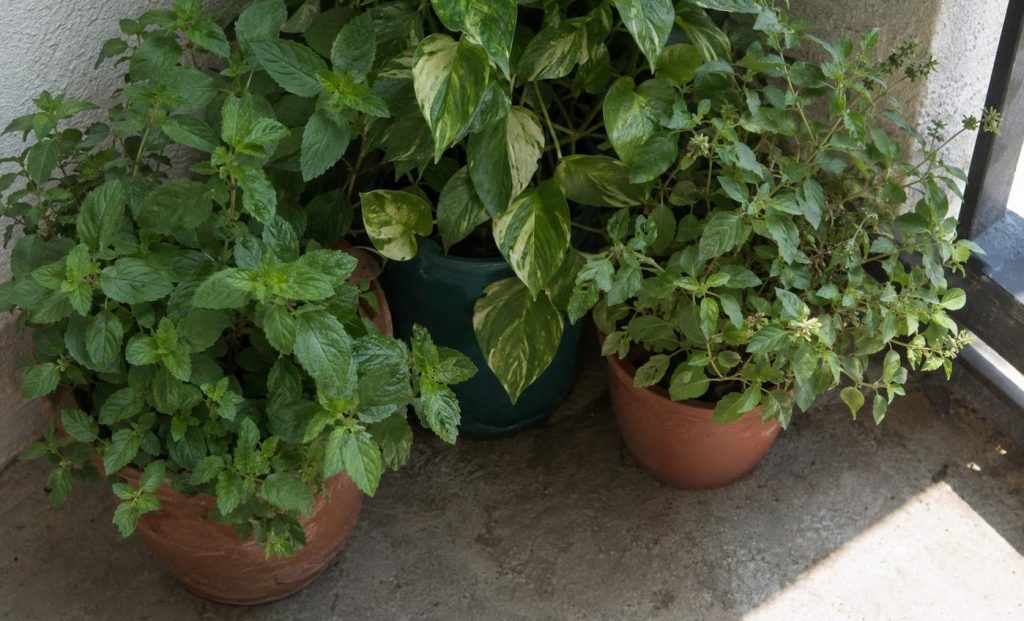
The same page says to push the pots together until their canopies touch. Leaves shading leaves cut evaporation from the mix below.
Grouped and shaded, an ordinary balcony pot goes from one day to three or four. That covers a long weekend with nothing bought.
Neither move costs anything.
University of Florida Extension adds a three-inch layer of mulch to hold moisture in, and agrees that grouped plants conserve water better than scattered ones.
Mulch on a container looks odd the first time. Bark chips, straw, or a folded square of shade cloth all work.
One warning about the shady corner. It has to be shade, not a hot wall, because a pot pressed against sun-baked masonry gets hotter, not cooler.
Leaves shading leaves cut evaporation from the mix below.
Past a week you need a reservoir or a person
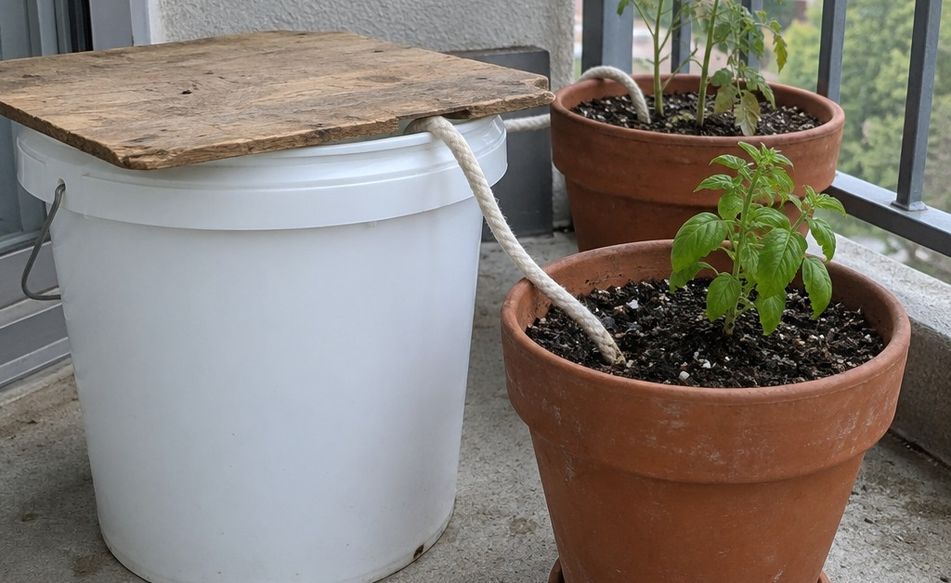
Three methods carry a pot past the point where shade and grouping run out:
- A self-watering container. Florida Extension describes a reservoir the plant draws on as it needs it.
- A wick. The same page runs cotton cords from a water container down into the mix, and puts it at an extra couple of weeks.
- A drip line on a timer. Kansas State notes that people with irrigation lines run their containers off a time clock.
A wick is the cheapest of the three and costs about as much as a ball of cotton cord. Run it from a covered bucket, over the rim, and a few inches down into the mix.
On a balcony, a battery timer screwed onto the tap works as well as a full irrigation system. It is the only one of the three that keeps working for a month.
And the simplest option is still a neighbor with a key. Kansas State says asking a friend to come and water is usually the simplest answer, and it is.
What is worth buying
Almost none of this costs money. A wick is cotton cord and a bucket, and shade and grouping are free.
The one thing worth paying for is the timer, because it is the only method here that holds for a month. To see what is sold for this, you can compare drip irrigation kits with timers on Amazon.
Check the number of drippers against the number of pots you actually have. A four-dripper kit on nine pots leaves five of them dry.
Heads up: some links on this page are affiliate links. Buying through them supports the site with a small commission and does not raise your price.
The pots this will not save
Some containers will not make a week however carefully you prepare them.
Three kinds of pot fail first, whatever you do outside:
- A seedling in a 4-inch pot, which holds almost no water at all.
- A tomato carrying fruit, which is drinking hardest exactly when you leave.
- Anything standing in full afternoon sun with no shade to move to.
They drink faster than any passive trick can supply.
Those three come indoors.
Kansas State reports setting containers in a kitchen sink and having them do fine for almost a week. Move them to a bright window or a sink before you go.
The other honest fix is a bigger pot next season. Volume is the single biggest lever on how often you water, which is why choosing the right container size matters more than beginners expect.
Set the pots out in their shaded group the evening before, water them properly then, and leave in the morning without touching them again.