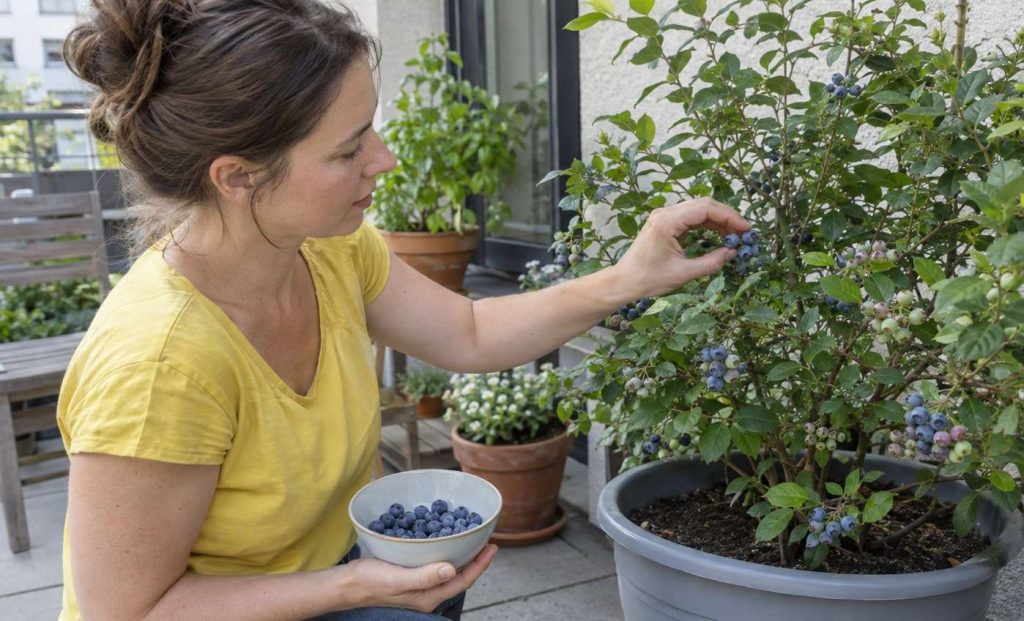
The first thing a potted blueberry needs is an acidic mix.
After that you need a big pot, a second variety for a better crop, a steady watering habit and a sheltered spot for winter.
For one or two bushes on a patio, pick a small type, a pot of 10 gallons or more, and an acidic mix.
Why blueberries need an acidic mix
Wisconsin Horticulture is the University of Wisconsin’s Extension gardening site. It says blueberries want a soil pH in the range of 4.5 to 5.0.
pH is a scale of how acidic a mix is, where lower means more acid. Oregon State University Extension, the university’s community education service, gives 4.5 to 5.5.
Wisconsin points out that many of its soils are too alkaline for that.
Its answer is to grow blueberries in a container filled with an acidic soilless mix (a mix with no soil in it).
Fill the pot with an acidic soilless mix, never garden soil.
Wisconsin gives two recipes:
- One part sphagnum peat moss and one part shredded pine bark.
- Two parts coir (shredded coconut husk), two parts sphagnum peat moss and one part perlite.
Oregon State leans on bark instead: 50% to 80% well-aged fine bark, 10% to 40% peat moss and about 10% perlite or pumice.
It adds that the mix should not contain lime or a high proportion of compost.
Garden soil is the one to avoid in any pot. It compacts and holds more water than roots can use, as the potting mix guide explains.
To see what is sold for blending your own, you can compare sphagnum peat moss on Amazon.
Heads up: some links on this page are affiliate links. Buying through them supports the site with a small commission and does not raise your price.
How big the pot needs to be
Oregon State says half-high types (the shorter blueberry bushes) perform best in a 10-gallon or larger container.
The pot should have drain holes at the bottom.
You can start smaller. Wisconsin plants a single bush in a five-gallon container, then moves it to a 16 or 20 inch pot or a barrel as it matures.
Plan for a 10-gallon pot or bigger once the bush is established.
University of Maryland Extension, a statewide, non-formal education system, puts mature plants in a container at least 24 inches deep and about 24 to 30 inches wide.
Avoid black pots. Wisconsin notes they absorb heat and lose moisture faster.
Types that stay small
Low bush and half-high types are the ones to look for.
They stay far shorter than the northern highbush type, which Oregon State says grows 6 to 7 feet high at maturity.
| Variety | Type | Height | Hardy to | Source |
|---|---|---|---|---|
| Top Hat | Low bush | Up to 12 inches | Zone 5 | Wisconsin |
| Northblue | Half-high | Up to 3 feet | Zones 3 to 5 | Oregon State, Wisconsin |
| Northcountry | Half-high | Up to 3 feet | Zones 3 to 5 | Oregon State, Wisconsin |
| Sunshine Blue | – | 3 to 4 feet | – | Illinois |
Top Hat is the smallest at 12 inches, and Sunshine Blue is the largest at up to 4 feet.
A hardiness zone is a map rating of winter cold, and it describes a plant in the ground.
Plant two varieties
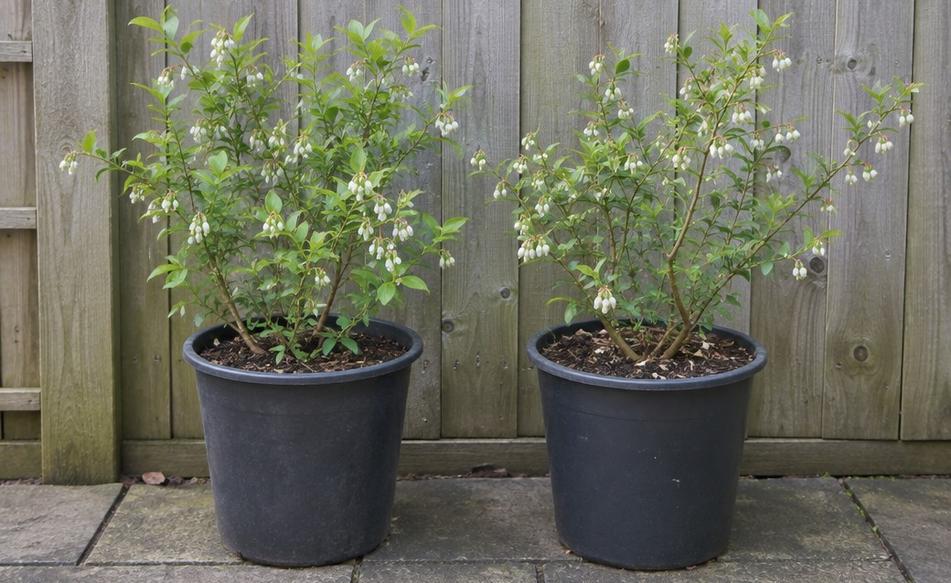
Most blueberries are self-fruitful, Wisconsin says, which means one bush can set fruit alone.
Even so, growing more than one variety improves pollination and enhances yield and berry size.
For half-high types, Oregon State says they do not produce much fruit with self-pollination, so choose more than one half-high cultivar.
Maryland says planting another variety in a separate container will encourage cross-pollination, as long as both bloom at the same time.
Two varieties in two pots give a better crop than one.
Expect no berries the first year, and a full crop only after about five years, per Maryland.
Water the mix, ideally with rainwater
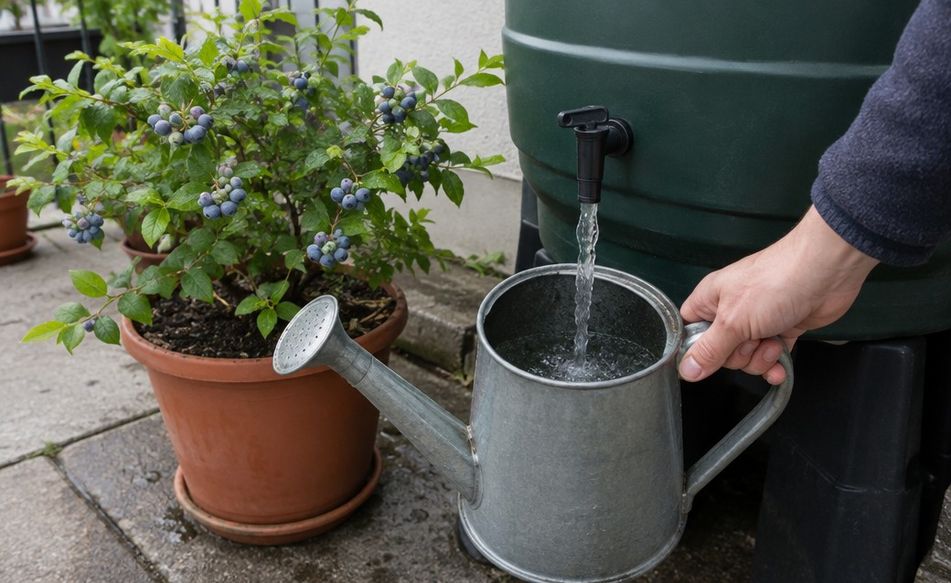
Blueberries are very sensitive to dry conditions, Maryland says, so keep the mix evenly moist.
Wisconsin puts the target as moist but not wet or soggy.
Pots dry out fast on a patio in summer. Where pots sit on hard surfaces, Maryland says to put them on bricks for drainage.
Collected rainwater is the best water for a blueberry pot.
Wisconsin says it typically isn’t as hard as well water and doesn’t have as high a pH.
Winter care
Blueberries go dormant in winter, and a pot needs more protection than the same bush in the ground.
Maryland says containers should sit in a sheltered location, protected from winter winds, from December to March.
Wisconsin, writing for zones 3 to 5, buries pots in mid- to late October where snow will pile up.
It covers the surface with four to eight inches of straw in mid-November.
One author at Illinois Extension, part of the College of Agricultural, Consumer & Environmental Sciences, moved both pots into an attached, unheated garage instead.
They were watered about every other month, the leaves dropped, and the plants came back in early spring.
If a pot can’t be buried, the guide to potted plants outside in winter covers wall placement and mulch.
Whichever route you take, keep the pot out of the wind until spring.
What to check in spring
Maryland says to fertilize in early spring before leaves expand, with an acidic-based fertilizer and no nitrates or chlorides.
Wisconsin moves buried containers back into full sun in early to mid-spring.
In early to mid-spring, check each bush for new growth as the weather warms, then move the pot into full sun.