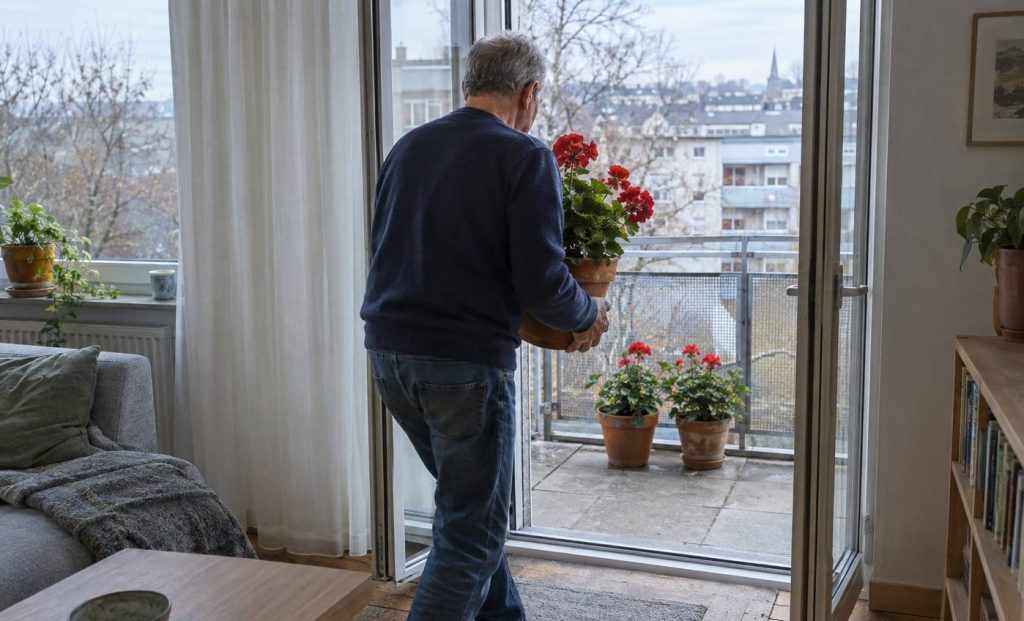
The first frost is in the forecast, and your geraniums are still sitting in their pots on the balcony.
Left outside for the winter, they will not be there in spring.
University extension advice is to move them, or take cuttings, before frost or a hard freeze.
A geranium can be kept for next year, and there are three ways to do it. Keep the whole plant as a houseplant by a bright window, root cuttings, or store the plant dormant in a cool place.
For a small apartment, cuttings take the least room.
Which plants this covers
The geraniums sold in pots for balconies are Pelargonium, a plant from warm climates. Zonal and ivy types both belong to that group.
Pelargoniums are tender and do not survive a winter outside, which is why they need a plan. The University of Wisconsin’s Division of Extension, the university’s outreach service, whose horticulture team answers gardeners’ questions, calls them tender geraniums.
Hardy Geranium species, also called cranesbill, are a different plant. They stay outside, like the hardy potted plants that can stay outside through winter.
Many balcony growers bring rosemary in too, and a bright window suits it as well.
When to bring them in
Iowa State University’s extension service, which takes gardeners’ questions online, says to remove plants before the first fall frost or take cuttings by then.
Wisconsin words it a little differently. Its trigger is a hard freeze, which comes later than a first frost.
Go by the earlier of the two, the first frost. A forecast low near freezing is the signal.
Wisconsin also says to check for unwanted hitchhikers before a pot comes in. Look under the leaves and on the soil surface first.
Overwinter healthy plants only, which Wisconsin says gives the best chance of success.
Method one: keep it as a houseplant
For a plant already in a pot, this needs no digging. Wisconsin says to move it indoors, trim it back by one-third to one-half, water it well and set it in a sunny spot.
The catch is light. Wisconsin says reduced light often makes geraniums leggy, so a sunny sill or a lamp is what they need.
If you have no bright window, artificial lighting works, alone or mixed with daylight. Keep the pot away from heat vents and a fireplace.
On temperature, the two services give slightly different figures. Wisconsin gives 60 to 65 degrees F, while Iowa State calls daytime 65 to 70 degrees Fahrenheit ideal, with slightly cooler nights.
Treat 60 to 70 degrees as the range and keep the plant out of the warmest room. A cool room fits.
Check the soil with a finger before each watering.
Water when the soil feels dry to the touch. If the stems turn leggy, pinch them back just above a leaf node.
If you have no bright window, artificial lighting works, alone or mixed with daylight.
Method two: take cuttings
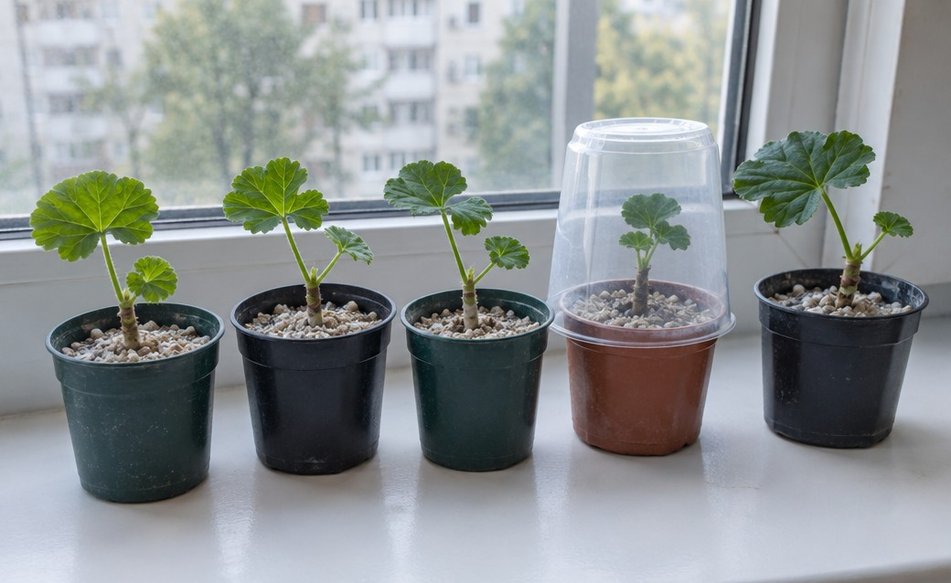
Cuttings fit the smallest space, because a few small pots replace one large plant. Wisconsin says this works especially well when you cannot keep big pots.
Here is the sequence, using what both services describe:
- Cut a 3 to 4 inch piece from the tip of a healthy stem.
- Pinch off the lower leaves and dip the cut end in rooting hormone.
- Push it into a rooting medium in a container with drainage holes: perlite and peat moss, sand, or vermiculite.
- Keep the medium moist, in bright light but out of direct sun.
Iowa State adds a clear plastic bag or dome over the cuttings, so the leaves do not wilt.
Expect about six weeks for roots, and as long as eight. Wisconsin says about 6 weeks, and Iowa State says 6 to 8 weeks.
Once the roots are good, move each cutting into its own pot of potting mix. Keep them in a bright spot until spring.
Water each new pot when the soil gets dry.
Method three: store the plant dormant
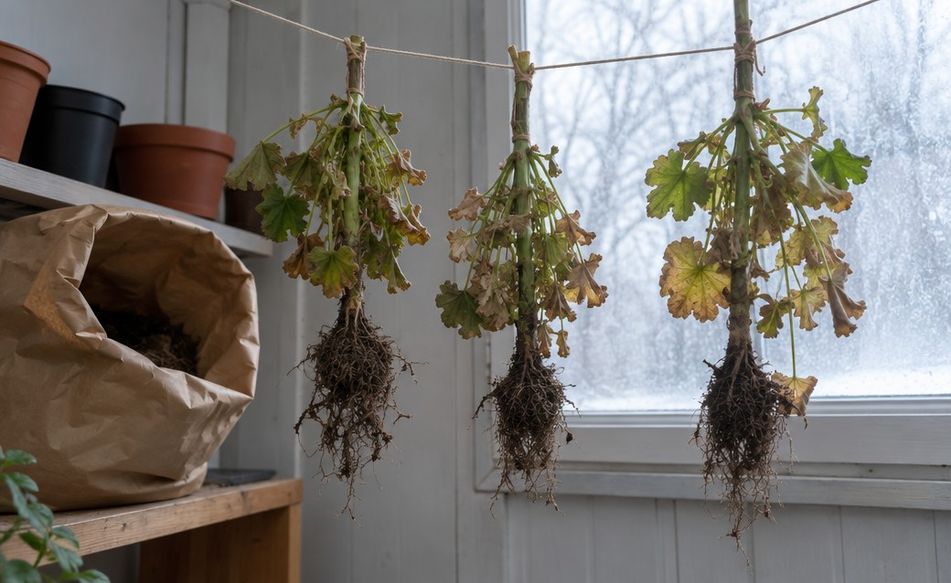
This is the only method Wisconsin warns may fail, and it needs a cool place. Wisconsin calls it a challenge, and suggests taking cuttings as a backup.
Both services describe the same steps. Dig or knock the plant out before the frost and shake the soil off the roots.
Then keep it dry and cool. Wisconsin gives cool (45 to 55 degrees F), dry, and Iowa State gives the same range:
- Put one or two plants in a large paper sack, kept open for air.
- Or hang them upside down in a cool, dry spot.
- Choose an unheated bedroom, an indoor porch, a cool basement or a garage.
Do not be alarmed when the leaves dry up and drop. That is expected.
Wisconsin adds that some gardeners soak the roots in water for a few hours, several times over the winter.
If you have nowhere to hang it, a paper bag in that cool spot works. Check that the spot stays in that 45 to 55 degree range.
Which method suits an apartment
Cuttings suit a small apartment best, because they need little space. The table puts the three side by side.
| Method | Space and effort | What you have in spring |
|---|---|---|
| Houseplant | A bright window or a lamp for each pot. Low effort, a trim and a pinch. | The whole plant, leggy, ready for a cut back |
| Cuttings | A tray of small pots on one sill. Moderate effort for the first weeks. | Several small young plants |
| Dormant | A cool, dry spot and a paper bag. Low effort, but a real chance of loss. | Bare stems that wake slowly, if they survive |
Use your sunniest window, and judge its light as you would for how much sun a balcony gets.
If your apartment has no cool spare spot, skip the dormant method.
Take cuttings instead, which need little space.
Two things that make it easier
Two things make this easier: a lamp if your windows are dim, and the rooting hormone both services use for cuttings.
You can compare clip-on grow lights on Amazon, and compare rooting hormone powders on Amazon if you take cuttings.
A note: some links on this page are affiliate links. If you order through one, the site gets a small cut and your price is unchanged.
What to do in spring
Cut back first, move outside last. Wisconsin says plants stored dormant should be cut back in March, and Iowa State says to cut a houseplant geranium back by one-half to two-thirds.
For a dormant plant, cut down to firm green tissue and remove anything shriveled. Pot it up and water it well.
Put the potted plant in a bright spot. A dormant one can take a while to start growing.
For a plant kept as a houseplant, Iowa State says new growth starts within a few days of pruning.
Iowa State says plants pruned and potted in March can be planted outdoors in May. Wisconsin says to keep them indoors until the threat of frost has passed.
Prune in March, then set the pots back outside once the last frost has passed; Iowa State gives May for planting out.