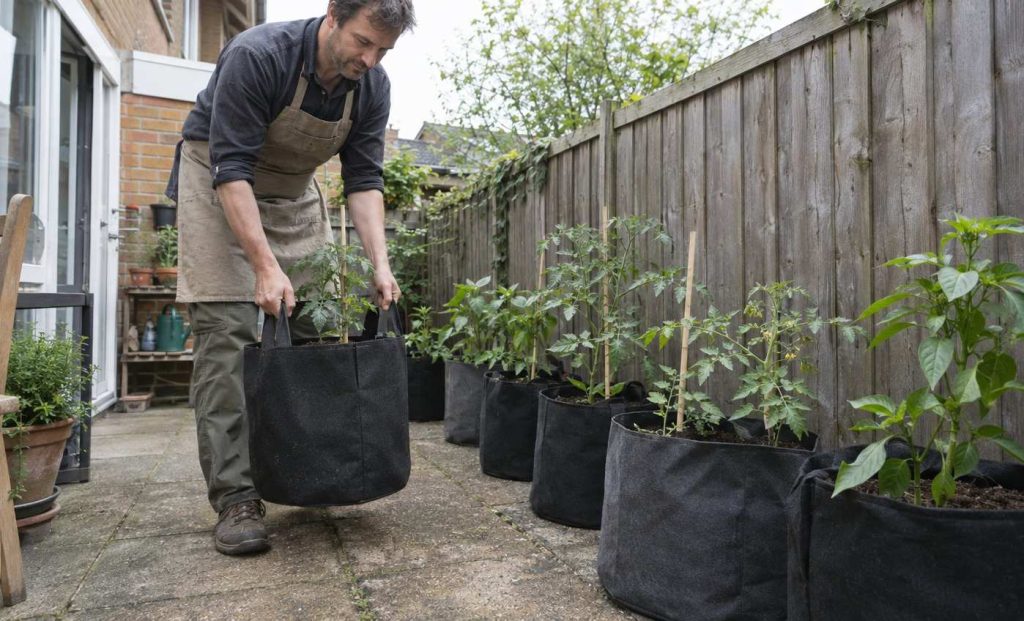
For summer vegetables on a patio, try a fabric grow bag first, and check it for water every day until you learn how fast it dries.
Start with the VIVOSUN 5 gallon bags with handles, which suit herbs, lettuce and cherry tomatoes.
A note: some links on this page are affiliate links. Buying through them supports the site with a small commission.
The five, at a glance:
- VIVOSUN 5 gallon grow bags with handles, 5-pack: herbs, lettuce, a cherry tomato.
- JERIA 7 gallon grow bags, 12-pack: a dwarf tomato or pepper, with bags to spare.
- JNYONG 10 gallon grow bags, 12-pack: a large tomato or pepper, one plant per bag.
- SORANGEUN 15 gallon potato grow bags, 2-pack: potatoes, with two flaps for checking the crop.
- Smart Pots Big Bag Bed Junior: a small fabric bed instead of single bags.
VIVOSUN 5 gallon grow bags with handles, 5-pack
Herbs, lettuce or one cherry tomato on a patio, in a bag with handles you can carry.
 VIVOSUN 5-Pack 5 Gallon Grow Bags with Handles
300g thickened nonwoven fabric
Handles sewn on with serger stitches
Check the Amazon price
VIVOSUN 5-Pack 5 Gallon Grow Bags with Handles
300g thickened nonwoven fabric
Handles sewn on with serger stitches
Check the Amazon price
University of Maryland Extension, a statewide education system run through the university’s agriculture college, lists 2 gallons as the minimum for a cherry tomato.
It lists 2 to 5 gallons for small herbs, so a 5 gallon bag meets both.
VIVOSUN makes the bags from 300g thickened nonwoven fabric (pressed fibers, not woven threads) and calls them moderately permeable. The handles are sewn on with serger stitches to hold a full bag of soil.
- Not needed if
- A large tomato or pepper (that is the 10 gallon bag)
JERIA 7 gallon grow bags, 12-pack
A dwarf tomato or pepper, or a patio that needs many bags at once.
 JERIA 12-Pack 7 Gallon Grow Bags with Handles
300G thickened nonwoven fabric
Built-in handles, folds for storage
Check the Amazon price
JERIA 12-Pack 7 Gallon Grow Bags with Handles
300G thickened nonwoven fabric
Built-in handles, folds for storage
Check the Amazon price
Maryland’s container guide gives 4 to 6 gallons of growing media as the minimum for dwarf varieties of pepper, eggplant and tomato. A 7 gallon bag clears that.
It falls short of the 8 to 10 gallons the same guide asks for large vegetables such as tomatoes and peppers.
JERIA lists a 300G thickened nonwoven fabric with built-in handles, and the bags fold for storage.
- Not needed if
- A large tomato or pepper (the 10 gallon bag)
JNYONG 10 gallon grow bags, 12-pack
A large tomato or pepper, one plant per bag.
 JNYONG 12-Pack 10 Gallon Non-Woven Grow Bags
Thickened non-woven polypropylene
Aeration channels, wide handle
Check the Amazon price
JNYONG 12-Pack 10 Gallon Non-Woven Grow Bags
Thickened non-woven polypropylene
Aeration channels, wide handle
Check the Amazon price
At 10 gallons, this bag meets the 8 to 10 gallons of growing media Maryland’s container guide sets for large vegetables. The guide names tomatoes, pepper, eggplant, cucumber and winter squash, one plant per container.
JNYONG says the polypropylene is BPA-free, the bags can be reused year after year, and aeration channels keep roots from tangling. A wide handle makes them easy to move.
- Not needed if
- Herbs or lettuce (the 5 gallon bags hold enough)
SORANGEUN 15 gallon potato grow bags, 2-pack
Potatoes, where you want to check the crop without digging the whole bag out.
 SORANGEUN 15 Gallon Potato Grow Bags, 2-Pack
Two Velcro flaps for checking and harvesting
500G fabric, 15 in wide by 20 in tall
Check the Amazon price
SORANGEUN 15 Gallon Potato Grow Bags, 2-Pack
Two Velcro flaps for checking and harvesting
500G fabric, 15 in wide by 20 in tall
Check the Amazon price
SORANGEUN gives each bag two Velcro windows and says they let you monitor and harvest potatoes without disturbing the roots. Each bag is 15 inches wide and 20 inches tall, with reinforced handles.
Maryland shows three potato plants in a 5 gallon fabric bag. Its container guide lists 30 gallons of potting mix for potatoes, and this bag sits between the two.
The bags also fold up for storage.
- Not needed if
- Herbs, lettuce or a single small plant (the 5 gallon bags)
Smart Pots Big Bag Bed Junior
A small herb or vegetable bed on a patio instead of separate bags.
 Smart Pots Big Bag Bed Junior Fabric Raised Bed
Unfold, fill and grow
Air-prunes roots, 7.1 feet of growing space
Check the Amazon price
Smart Pots Big Bag Bed Junior Fabric Raised Bed
Unfold, fill and grow
Air-prunes roots, 7.1 feet of growing space
Check the Amazon price
Smart Pot lists the bed as unfolding, filling and planting, with no assembly. It gives 7.1 feet of growing space, enough for an herb garden or a small vegetable or flower garden.
Its fabric air-prunes roots, the same effect Maryland describes for bags.
- Not needed if
- One plant (any single bag above)
Fabric or plastic, row by row
Maryland says fabric bags air-prune roots, so they branch into a denser, fibrous root system.
| Fabric bag | Plastic pot | |
|---|---|---|
| Drying out | VIVOSUN: does not retain excess water | Maryland: dries out more slowly than clay, concrete or wood |
| Lifespan | Maryland: reusable; VIVOSUN: years | Maryland: plastic not made for outdoor use can become brittle |
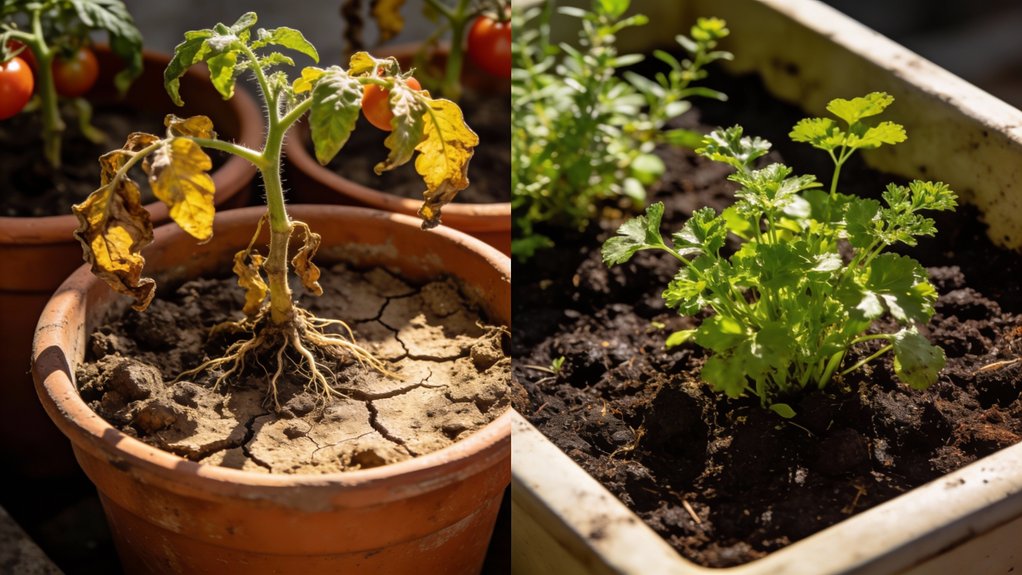
Check a fabric bag for water every day in summer until you know how fast it dries. Maryland advises a daily check for any container, and says small containers dry out faster than large ones.
What size bag for which crop
Match the bag to the plant at full size, and go to the larger bag when two figures disagree. Find the crop in the table.
| Your pots and space | Start with this |
|---|---|
| Herbs, lettuce or one cherry tomato | VIVOSUN 5 gallon grow bags with handles, 5-pack |
| A dwarf tomato or pepper, many bags needed | JERIA 7 gallon grow bags, 12-pack |
| A large tomato or pepper, one plant per bag | JNYONG 10 gallon grow bags, 12-pack |
| Potatoes | SORANGEUN 15 gallon potato grow bags, 2-pack |
| A small bed of herbs or vegetables | Smart Pots Big Bag Bed Junior |
Large herbs such as rosemary, sage, parsley and lavender need 5 gallon pots or larger, Maryland says.
Plan the watering and size before you fill the bags
Maryland says containers in full sun dry out faster than those in shade, and container plants need frequent watering.
To learn the signs of a thirsty plant, read how often to water container plants. It also covers what makes pots dry out faster.
For a plant these bags do not cover, check the 1 to 2 inch rule and sizes for tomatoes, peppers and herbs. For one tomato plant, growing tomatoes in pots covers varieties, sun, support, watering and feeding.
Reusing the bags
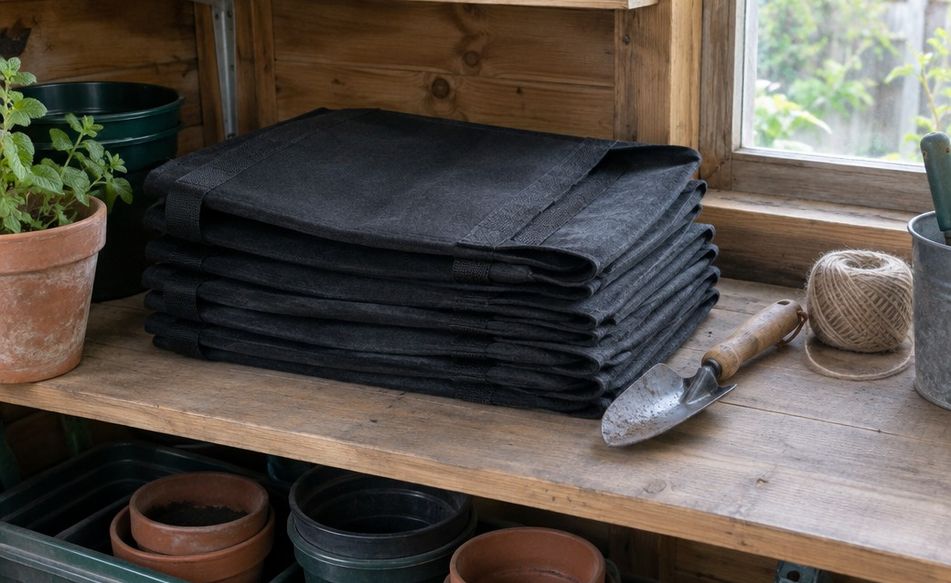
Maryland calls fabric bags reusable, and VIVOSUN and JNYONG say the same of theirs. The JERIA and SORANGEUN bags also fold flat for storage.
At the end of the season, empty each bag and fold it flat for storage.