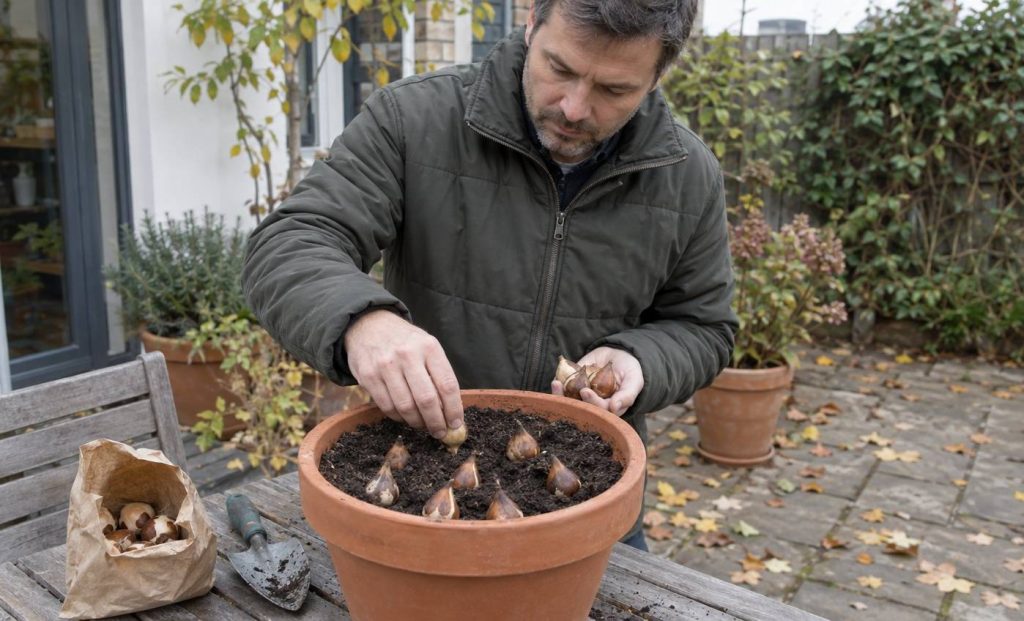
Yes, tulips and daffodils grow well in pots. The two biggest differences from planting in the ground are how deep the bulbs go and where the pot spends the winter.
In a pot, bulbs sit shallower and closer together than in a bed, and the pot needs a cold but not frozen spot until spring.
Crocus and hyacinths are planted the same way, and a single pot of any of them is enough for a first try.
Which bulbs suit a pot
Tulips, daffodils, hyacinths and crocus all work. Iowa State University Extension, the state university’s free public gardening service, lists all four among its spring-flowering bulbs.
Iowa State says the bigger the bulb, the better the flower display.
Tulips and daffodils are among the easiest to start with, and hyacinths are the one to watch in winter.
Ask Extension is a question service where Extension experts answer gardeners. A gardener quoted there found hyacinths less winter-hardy than tulips in a detached garage.
The same page warns that bulbs sitting too wet for too long, especially tulips, will die.
Choose a pot with drainage holes, and skip the gravel at the bottom, because a layer of gravel does not improve drainage.
What to buy before fall
A pot, potting mix and bulbs cover it. Ask Extension says to use potting mix, not soil from outdoors.
Ask Extension suggests small 6-inch or 8-inch plastic pots that you can carry into a garage for winter. The layered method below needs a deeper pot.
To see what is sold, you can compare spring flowering bulbs for fall planting on Amazon and plastic planters with drainage holes on Amazon.
A note: some links on this page are affiliate links. Buying through them gives the site a small commission and does not change what you pay.
Buy the largest bulbs on offer, and buy more than you think the pot needs. They go in close together.
Depth and spacing are different in a pot
Iowa State gives the ground figures. Larger bulbs like tulips, daffodils and hyacinths are often planted 6 to 8 inches deep, and crocus 3 to 4 inches deep.
Larger bulbs sit 4 to 6 inches apart in a bed.
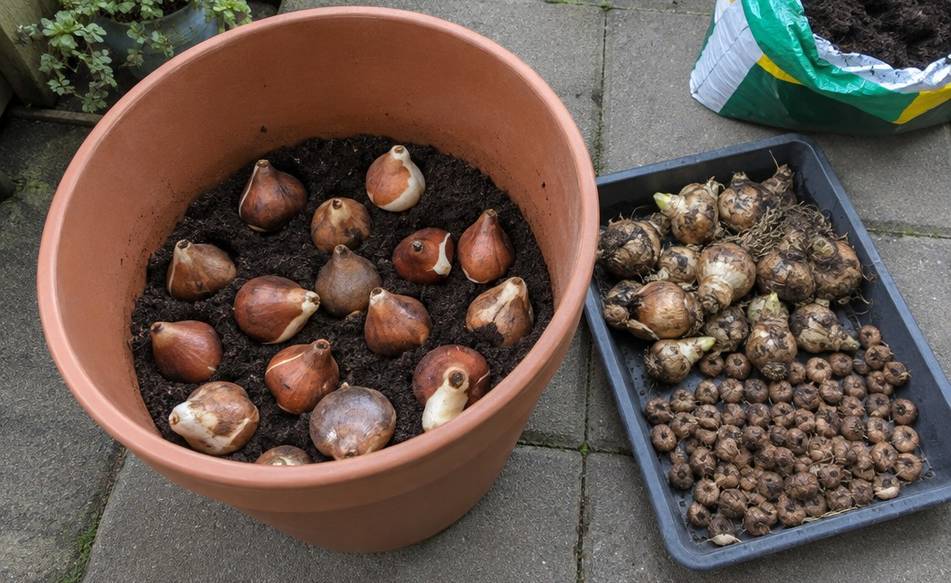
In a pot, set them close enough that they nearly touch.
Ask Extension says bulbs in pots are typically planted much closer together and less deep than bulbs in the ground. Close but not touching, with the tips just below the soil surface.
Illinois Extension, the University of Illinois’ advice service for home gardeners, fills the pot until only the tips show. Ask Extension keeps the tips just below the surface.
Both are far shallower than the 6 to 8 inches used in a bed.
Leave as much room as you can under the bulbs, because that is where the roots grow.
One exception applies. A container so big it works like a garden bed, such as one on a roof, takes the standard ground depths and spacing.
Layering bulbs in one pot (the lasagna method)
Layering stacks bulbs at different depths so one pot flowers in a sequence. The University of Georgia’s extension service describes it for planters as well as beds.
Work from the bottom up. Tulips go deepest and flower last. Crocus go nearest the top and flower first.
- Bottom: a base of potting mix, then the tulips, pointed ends up.
- Middle: 1 to 2 inches of mix, then the daffodils.
- Top: 1 to 2 inches of mix, then the crocus.
- Finish: a last covering of mix, then water well.
Georgia’s own wording is to cover each layer with 1 to 2 inches of soil before placing the next. Illinois Extension agrees that tulips and daffodils can be fully covered and crocus planted on top.
Extension advice splits on this point. Ask Extension recommends one kind of bulb per pot, because rooting and blooming times vary so much that mixed pots often disappoint.
If you have a spare pot, a mixed one is worth a try. Start with a single kind if you have only one.
Where the pot spends the winter
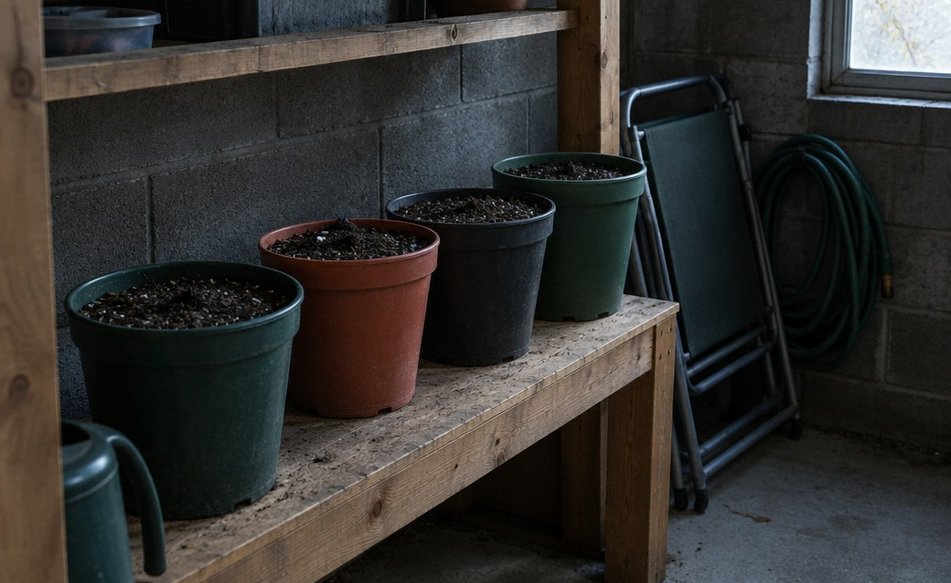
Bulbs need weeks of cold to flower, so keep the pot cold but not frozen. Illinois Extension says most bulbs need 12 to 15 weeks of chilling, in a cool, dark spot at 35 to 45°F.
The Extension sources disagree on how cold is too cold. Ask Extension wants a place that stays colder than 48°F most of the time but does not freeze, like a basement or garage.
Illinois Extension allows an unheated garage down to 20°F. Ask Extension notes that most detached garages offer very little protection from the cold, so treat the lower figure with caution.
In the northeast, Ask Extension says winters are too severe to risk leaving pots outdoors unless they are insulated heavily. Which pots can stay outside through winter depends on where you live.
Check the mix with a finger at least once a week.
Press a finger into the mix: damp is right, soggy is too wet.
What to do with the pot after the flowers fade
Snip off the faded flowers.
Leave the leaves alone. Illinois Extension says to wait until the foliage turns yellow, usually about 6 to 8 weeks after the flowers fade.
Those leaves feed the bulb for next year. Cutting them early leaves the bulb less time to rebuild.
Expect less from tulips and hyacinths after a year or two. Georgia says they may fail to bloom at all. Illinois Extension adds that flower production can decline as bulbs crowd, more so with tulips.
Once the leaves have browned, empty the pot and let the bulbs dry for a few weeks. Keep them somewhere cool and dry, then replant them, or fresh bulbs, in fresh mix next fall.